While I was having a walk in the garden of my resort in Tomohon, Sulawesi 2 weeks ago, I saw some familiar birds flying around a palm tree. It didn't cross my mind that they are collecting nesting material (lichen). When I saw it again the next day, I decided to take out my camera & trying to capture some flight shot. After looking at the image than I realize the small swiflets indeed are Glossy swiftlets (Collocalia esculenta). They are actually collecting lichen. Below are some of the photos that I have taken.
The swiftlet started to slow down and hover about 50cm away from the palm tree.
The swiftlet approach the palm tree without physically get contact with the palm tree!
The swiftlet pull the lichen while still hover in the air.
The swiftlet continue to hover and move away from the palm tree.
This is another series of photo coming from a different angle.
Again, the swiftlet just "touch and go". Since swift spend most of their time in flight and hardly or never settle on the ground voluntarily. That explain why they have a very short legs and they use their leg only for clinging to vertical surfaces.
I'm not sure why the swiftlet turn the head upside down. Glossy swiftlets can be found from India all the way to Australia. Hopefully I can capture some video the next time if I see them in Singapore.


 This is the female sunbird (without the blue patch on their throat)

 Both male & female check & inspect their nest.
 I don't know what this female bird is doing initially. Saw the bird peck on the fern that their nest attached too. After upload to the computer then I know the answer.


 Beautiful Pink necked green pigeon
 Yellow vented
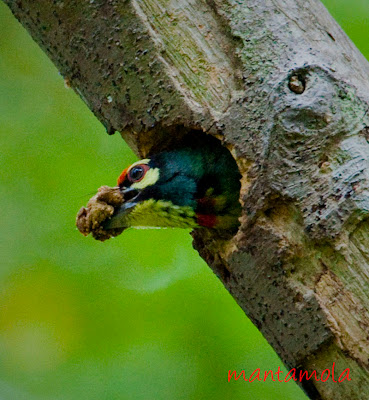
 So as this Large bill crow!


 After the sharp turns, the Oriole finally fly towards the nest and landed on top of the nest. The nest was about 15 meters above ground.
 It continue on the look out even after landed on the nest.
 The Oriole keep calling and continue on the look out. Apparently, this Oriole was actually calling the female that was inside the nest. I will assume the nest was just completed and waiting to lay egg soon.
 Before both of the Oriole set off, they take a final check to make sure there is no predator around.

 The female follow behind.
 The cup shape nest was made from grass, twig, bark and roots. Hope to see the next generation in 2 weeks time.