Showing posts with label North Sulawesi. Show all posts

Sunday, June 15, 2014

Meeting With Maleo - an endangered bird

After 4 years of waiting, I finally get to see the wild Maleo (Macrocephalon maleo) the chicken like bird that don't incubate their egg or feed their youngs. I didn't get the chance to see Maleo when I first visited Tangkoko National Park 4 yours ago. I was told that Maleo have been locally extinct in Tangkoko & another place to see Maleo is at Tambun in Bogani Nani Wartabone National Park. Due to ongoing habitat loss, limited range, high chick mortality rates and overhunting, the Maleo is evaluated as Endangered on the IUCN Red List of Threatened Species. Endemic to Sulawesi, the only area to meet Maleo is here and no where else.
North Sulawesi
After arrive at Manado Airport and meet up with our local guide, we start our long drive to Tambun. We took almost 8 hours to reach the nearby home stay which is another 45 minutes away from the Maleo nesting site.
Maleo Conservatrion
 We wake up at 4 am and start our journey to look for Maleo.
Maleo Conservatrion
Our target is to watch a wild Maleo in their natural habitat and look at how and where they lay their eggs. Maleo lay their eggs in the hole they dug and cover their eggs with sand and soil. The Maleo don't incubate their eggs & they rely on solar and/or geothermal radiation to incubate their eggs. The incubation took 2 to 3 months and the chick may took up to 2 days to dig their way up to the surface.Once on the surface, they are totally independent and ready to fly.
Hot spring
 These area are covered with hot spring and make it a perfect nesting site for Maleo.
The maleo (Macrocephalon maleo)
 After searching for about an hour, we get to see Maleo!
The maleo nest
 This could be a new nest looking at the newly covered soil.
The maleo nest
The staff from the Conservation Center show us how they retrieve the eggs from the nest and transfer to protected site for incubation. If let unprotected, the eggs and the newly hatched chicks are at high risks of predated by monitor lizard & wild pig.
The maleo egg
 The Maleo egg is about 5 times bigger than chicken eggs.
The maleo (Macrocephalon maleo)
We are so lucky that there are 2 newly hatched chicks in the center and ready to be released to the wild. I was given the honor to release one of the chick to the wild! The young Maleo is now on his own to defend himself from the predators hopefully he will come back to the nesting site & produce more young Maleo.
The maleo (Macrocephalon maleo)
I name this young bird Mini-Samson before letting it fly to the forest. Hope to see you again some day!

This trip was made possible with the logistics support from Manado Safari Tours - Thank you for the great service!

Wednesday, May 8, 2013

Crossing Wallace Line to Tomohon, North Sulawesi

This is Part 2 of my posting on my trip to North Sulawesi 2 weeks ago. You may read Part 1 Link  on my birding trip at Tangkoko.

Whenever I travel oversea, I will try and incorporate visiting to a local market into my itinerary. My last trip to Manado at North Sulawesi was no exception. I visited Tomohon market. Situated 700 m above sea level, Tomohon itself is a nice place to visit. 

Tomohon market, Minahasa, North Sulawesi.
 When I arrived at the market, saw this man just finish his shopping of the chickens.
Tomohon market, Minahasa, North Sulawesi.
 Some part of the market are sheltered and some part are open air.
Tomohon market, Minahasa, North Sulawesi.
 The locals can buy anything that they need from here. From vegetables, fruits, to spices and beans.
Tomohon market, Minahasa, North Sulawesi.
 The fruits here are so fresh & big. From the size of the papaya can tell that the soil here are very fertile!
Tomohon market, Minahasa, North Sulawesi.
 There is even a convenient shop inside the market.
Tomohon market, Minahasa, North Sulawesi.
There are also a lot of local snacks available in the market such as this "Apung". Very similar to the apung balik in Malaysia. The ingredient including rice flour, cinnamon, & palm sugar. In Malaysia, coconut sugar (gula Melaka) is used instead.
Tomohon market, Minahasa, North Sulawesi.
 This is the pan cake version of the apung.
Tomohon market, Minahasa, North Sulawesi.
This is the deep fried version of apung. Both also very nice!

We cross over to the meat section of the market. You will find all kind of meat from fish to pork...
Tomohon market, Minahasa, North Sulawesi.
 These are the fresh water fish
Tomohon market, Minahasa, North Sulawesi.
 These tuna was huge!
Tomohon market, Minahasa, North Sulawesi.
 Another huge yellow fin tuna.
Tomohon market, Minahasa, North Sulawesi.
 Not sure what fish is this.
Tomohon market, Minahasa, North Sulawesi.
 Smoked mackerel
Tomohon market, Minahasa, North Sulawesi.
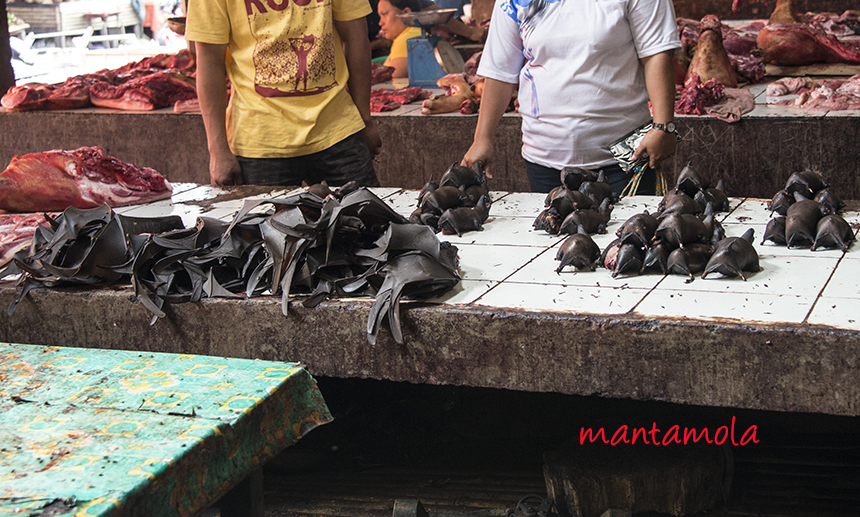
The meat section of Tomohon market is not for the faint-hearted one. Some part are quite gory, like the scene in the video game or movie.
Tomohon market, Minahasa, North Sulawesi.
 Bats
Tomohon market, Minahasa, North Sulawesi.
 Forest rats
Tomohon market, Minahasa, North Sulawesi.

Tomohon market, Minahasa, North Sulawesi.
 Python meat are available too.
Tomohon market, Minahasa, North Sulawesi.
 Wild pig is the most.
Tomohon market, Minahasa, North Sulawesi.
 After the market, I continue my trip to the nearby area.
Tomohon market, Minahasa, North Sulawesi.
 Tomohon is a very nice place to simply take photo, birding or just enjoy the nice weather.
Tomohon market, Minahasa, North Sulawesi.
I can even see Lembeh Island & Lembeh Strait from here. Lembeh is another of my favorite diving destination.
Tomohon market, Minahasa, North Sulawesi.
 Is a nice place to jog too!
Thank you Safari Tours , I have another good experience of Sulawesi.

Wednesday, July 7, 2010

My First Wallacea Birding

The first time I visited Manado, North Sulawesi was about 2 years ago on a 7 days dive trip. This time round, birding was added as part of the itinerary on top of just diving. I starts off with 3 days diving at Lembeh Straits, Lembeh is one of the best muck diving destination in the world before make our way to Tangkoko Nature Reserves.

I have never been bird watch at any of the area within the Wallacea boundary and Sulawesi is within the Wallacea boundary. Since this is going to be my first birding trip in Wallacea, any birds that we saw could be an endemic species!

We arrived at the reserves around 3pm and after settle down and rest for an hour, we set off at 5pm for our 1st night walk with our Ranger. The first mammal that we came across was the crested black macaques. It was about time for them to settle down and rest for the day. We move on deeper into the forest to look for the elusive yet super cute Tarsiers. Our ranger ask us to stop and wait around a big tree and told us to just wait till the surrounding get dark. Since Tarsiers are nocturnal animals, they will leave their nest for hunting at night. Suddenly we heard a rustling of leaves and branches in the nearby bushes. The Park Ranger quickly turned his torch in the direction of the noise, and yes! Is the Tarsiers!! They are so cute, is an amazing experience to be able to see this elusive tiny creature up close! After about few minutes, the ranger switch off the light to let the Tarsiers carry on their activities and switch the torch back on after the Tarsiers disappeared in the dense forest.

What an amazing experience to be able to see Tarsiers up close!

While on the way back to our cabin, the ranger show us the 1st bird of the trip! An endemic Sulawesi Scops-owl (Otus manadensis)!

Sulawesi Scops-owl (Otus manadensis)


I set my ISO to the highest to avoid using flash. I took a few shot as the ranger shine on the owl. The light from the torch is just good enough for me to focus and make some shots without causing too much stress for the bird. We sleep rather early on the first night as we will be going to the forest again the next morning around 4.30am.

We set off at 4.30am sharp and were greeted by flocks of Great Eared Nightjar.

We were at the forest all the way till about 1pm before we go back to our cabin. We were out for birding again in the afternoon at 4pm but this time round we were on the boat, travel around the coastal area into the mangrove. As we were too tired, we didn’t go for night walk and check out the next morning.

It was an fantastic birding trip. We were there for just 2 days and more than 40 species of birds have been observed with more than half of them endemic. These are some of the birds that we saw in just 2 days.

Silver-tipped Imperial Pigeon (Ducula luctuosa)

Green-backed Kingfisher (Actenoides monachus)

Knobbed Hornbill (Rhyticeros cassidix)
Not difficult to look for Yellow-billed Malkoha (Phaenicophaeus calyorhynchus), as they are always nearby Crested Black Macaques.
Crested Black Macaques. When they move from tree to tree, insect are flush out of the tree and exposed them to the waiting Yellow-Billed Malkoha.

White-breasted Wood-swallow (Artamus leucorhynchus)
I have no idea what bird is this with lots of worn out feathers.

Looks familiar yet different from the usual Brown-throated Sunbird, this is a sub-species of Brown-throated Sunbird ( Anthreptes malacensis heliocalus)
Another sub-species of Olive-backed Sunbird (Nectarinia jugularis plateni )
Buff-banded Rail (Gallirallus philippensis)
Chestnut Munia (Lonchura atricapilla)
Tangkoko is worth to go back again and again!