

To go to the inter-tidal area, we need to pass through a secondary forest. Not far from the entrance, we saw this grape-like fruits. I didn't know we have grapes in Singapore.

Saw this probably a big coachwhip ray (Himantura uarnak) stay motionless. Upon checking, found that is dead and the body has started to decompose.

This gave us a good chance to look at their lethar weapon that stingray use for their defense. (tips: never walk or step onto the seagrass area or when the water is too high that you can see the bottom. Another alternative is follow a experience guide.)

On one of the rock surface, we saw lots of sea slug (Oncidium Sp.) crawling. During high tide, they breath through trapped air under the rocks. As their colour usually matches with the rock surface, you will need to look carefully in order to spot them.

I saw this very rare heart shape cockle (Corculum sp.) Just look at the peraly white shell. Isn't it beautiful?

Ooh! The underside is really like a heart in red too!

We saw this reef eelnear the sea grass lagoon.

Yes. The iconic big sea star - a knobbly sea star (Protoreaster nodosus) One of the group posing with the Star of Semakau.

Also very close with the sea star (both echinoderms phylum, means spiny skin in Greek) a sea cucumber. This is a sypnatid (probably a Polyplectana kefersteinii) with the feeding tentacles out for feeding.

Saw another big Ocellated sea cucumber (Stichopus ocellatus) identified by its distinctive 'eyespots'.
 At the coral rubble area, we saw this polka dot (Jorunna funebris) nudibranch.
 Another green nudibranch (Ceratosoma sinuata) and lots of orange Gymmodoris rublopabulosa nudibranch.
 We also saw quite a few flatworm (different from a nudibranch, they don't have exposed gills as the nudibranch)
 Another flat worm
 This is giant clam (Tridacna squamosa) is getting very rare in Singapore.
 A very beautiful Fann Wong....oops! Is fan worm in white!
 And out of no where, I saw this Arcopora corals in white. Bleaching?
 And on the list, there are many interesting creatures that we saw... Indeed a very fruitful trip!


 The yellow flower that not more than 1cm in diameter is another carnivorous plants - bladderworts, that can be found here at Tuas. often look like miniature orchids and can have stunning colors and great beauty. Bladderworts have no roots. Their flowers are usually yellow and have two petals which look like lips.
 This bladderwort lives in shallow water with floating tangle of thin green thread and tiny bladders growing from it. It traps and eats mosquito larvae, miniature worms and other little animals it sucks into its underwater bladder-traps.
 However, the fate of this beautiful place just like their prey - the end is near! The construction will soon cover the entire area. . .


 Yes! Is nemo! I saw this famous cartoon character over at 2 different location.
 There's a fish in the above photo. Can you see it? Is a toadfish (Halophryne sp.) another fish that ambush its prey.

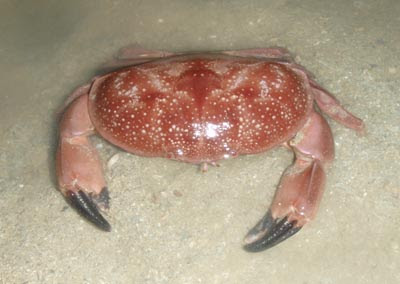 Red egg crab (Atergatis integerrimus)


 This sea cucumber (Stichopus ocellatus) really long. It measured about 45cm before fully extended. 2nd photo showing the sea cucumbers tube-feet.
 This thorny sea cucumber probably a Stichopus horrens
 This Sandfish sea cucumber really big!
 Another Sandfish sea cucumber was about to burrow into the sbstrate. The length of this sea cucumber is 30cm! What a big sea cucumber!
 As the night fall, octopus s also out for hunting. We saw quite a number of them. There are more things that was spotted.